
Who is this page for?
What each audience most needs:
- Public (pet owners, families, gardeners, hobby and backyard animal keepers): a plain explanation of what zoonoses are, the everyday things that lower risk, and when to get advice.
- Young people and families with young children: simple handwashing and farm or petting-zoo safety, as children under 5 are more at risk.
- Older people and anyone with a weakened immune system: a clear note that they are at higher risk and should take extra care.
- Pregnant women: the specific risks from cats (toxoplasmosis), from lambing, and from unpasteurised milk.
- Professionals (farmers, vets, abattoir and lab staff, healthcare and environmental health officers): occupational risk, COSHH duties and reporting routes).
What are zoonoses?
Zoonoses (pronounced “zoh-oh-NOH-seez”) are infections that can pass from animals to people. They can be caused by bacteria, viruses, parasites or fungi. Most people who have contact with animals do not become unwell. A few simple steps can help keep your risk low.
How infections spread?
You can catch these infections in several ways:
- Touching animals or their fur, skin or droppings, then touching your mouth or food before washing your hands
- Eating or drinking contaminated food or drink, such as undercooked meat or unpasteurised (“raw”) milk or cheese
- Animal bites or scratches
- Insect bites, such as ticks
- Breathing in dust or droplets in places where animals are kept
Who is most at risk?
Anyone can catch a zoonosis, but some people are more likely to become seriously unwell and should take extra care:
- Children under 5.
- Adults aged 65 and over.
- People with a weakened immune system (for example during cancer treatment).
- Pregnant women some infections can affect the pregnancy.
If you are in one of these groups, you can still enjoy animals just be extra careful with handwashing and avoid the higher-risk situations described below.
How can I protect myself and my family?
Most infections can be prevented with a few simple habits:
- Wash your hands with soap and warm water after touching animals, their housing or equipment, and always before eating or preparing food.
- Supervise young children around animals and help them wash their hands.
- Keep food and drink away from areas where animals are kept.
- Cook meat thoroughly and avoid unpasteurised milk and cheese.
- Cover cuts and grazes with a waterproof plaster before handling animals.
- Look after pets: including regular vet checks, worming and flea treatment
- Wear gloves when emptying litter trays or handling animal waste, and wash your hands afterwards.
Visiting farms, petting zoos and open farms
Farm visits can be a fun and safe day out if you follow basic hygiene advice:
- Wash hands with soap and water straight after touching animals and before eating don’t rely on hand gel alone.
- Do not eat or drink in animal areas; use the designated eating areas provided.
- Keep dummies, bottles and fingers out of mouths until all hands are washed.
- Do not touch animal droppings, and clean shoes afterwards.
- Clean footwear and buggy wheels after leaving
Tick bites and Lyme disease
Ticks are found in grassy and wooded areas. Some ticks carry Lyme disease.
To reduce your risk:
- Wear long trousers and cover your skin in long grass
- Use insect repellent
- Check your skin, children and pets after being outdoors
Remove ticks promptly using tweezers or a tick removal tool.
Contact your GP if you:
- feel unwell after a tick bite
- develop a spreading circular rash
Pregnancy: extra precautions
If you are pregnant, take a little extra care:
- Avoid contact with farm animals during lambing or birthing, especially sheep, goats and cattle, and new-born animals.
- Ask someone else to empty the cat litter tray; if you must do it, wear gloves and wash your hands.
- Avoid unpasteurised milk and cheese.
Speak to your midwife or GP if you are worried about contact with animals.
What should I do if I feel unwell?
Most mild stomach illnesses improve on their own. Rest and drink plenty of fluids.
Contact your GP (or phone first) if you or your child have:
- diarrhoea or vomiting that does not improve
- blood in your stools
- a high temperature or severe abdominal pain
- signs of dehydration
- illness after an animal bite or tick bite
Tell the doctor or nurse if you have had contact with animals.
In an emergency, call 999.
Common zoonotic diseases
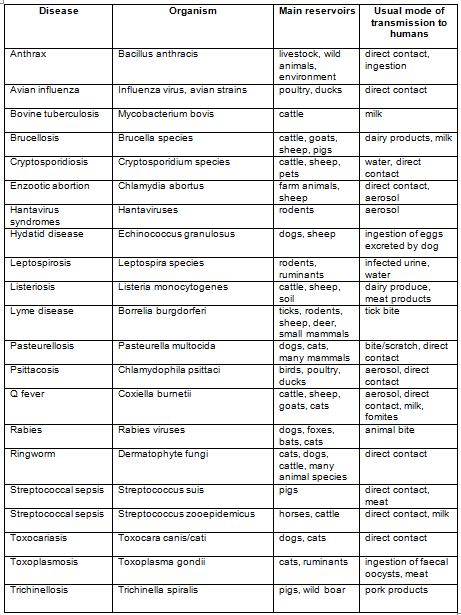
For further information on Zoonotic Diseases and Organisms click here.
Occupational guidance
Many zoonotic infections may be contracted at work usually through direct contact with infected animals. The true incidence of zoonoses acquired at work in the UK is unknown for most infections.
Specific regulations apply in the workplace to prevent, control the spread of, and report zoonotic infections. These are detailed below:
Regulations applicable in the occupational setting
- Control of Substances Hazardous to Health (COSSH) 2002.Micro-organisms which are hazardous to human health are included as substances hazardous to health in these regulations. As potentially zoonotic pathogens may be present wherever there are animals, an assessment of the hazard and its associated risk must be undertaken in such situations, and appropriate controls put in place.
Detailed advice on this process is available from the HSE - http://www.hse.gov.uk/risk/fivesteps.htm
- Reporting of Injuries diseases and dangerous occurrences (RIDDOR) 1985 www.hse.gov.uk/riddor/riddor.htmReporting accidents and ill health at work is a legal requirement, and included under the legislation are occupationally-acquired zoonoses.
Occupational settings
A wide variety of occupations and premises exist where contact with animals or their products may occur. These include professions such as abattoir workers, farmers and farm workers and forestry workers.